Steep Block Landscaping Solutions for Melbourne's Hilly Suburbs
Transform your challenging sloping property into a stunning outdoor space. Expert solutions for retaining walls, terracing, and drainage in Melbourne's northeast.
Based on the input provided, here is the enriched and rewritten MDX content.
Melbourne’s northeast suburbs share a specific geographical blessing that often feels like a curse. While areas like Eltham, Diamond Creek, Templestowe, and Warrandyte are celebrated for their rolling hills and native bushland, these features create significant engineering hurdles for homeowners.
You might look at that incline and see nothing but wasted space or a maintenance nightmare.
That reaction is completely normal.
From our perspective, having spent over four decades working with the unique clay soils and topography of this region, a steep block is actually an asset in disguise. Our steep block landscaping expertise transforms these challenging sites into stunning outdoor spaces. It is the defining feature that separates a standard flat garden from a multi-dimensional landscape.
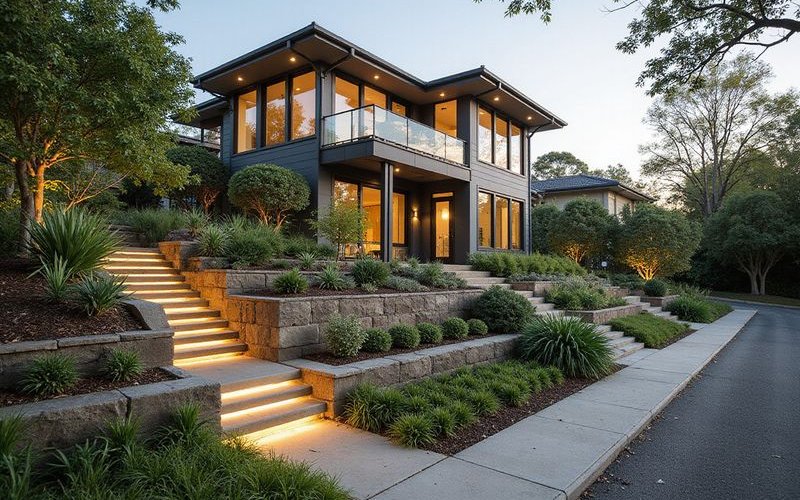
Understanding Your Steep Block
What Makes a Block “Steep”?
Most people know a slope when they see one, but technical definitions matter for planning. In Victoria, specific gradients trigger different planning and construction requirements.
A block is generally classified as “steep” when:
- The Gradient Ratio: The slope exceeds 1:6 (rising 1 metre for every 6 metres horizontally).
- The “Angle of Repose”: The soil cannot support its own weight without reinforcement, often around 30 to 35 degrees for local clay soils.
- Site Access: Standard machinery cannot operate safely without creating specialized benches or ramps.
- Visible Instability: There is evidence of soil creep, such as tilted fence lines or exposed tree roots.
Common Challenges
The physics of a sloping site creates pressures that flat blocks simply do not face.
Access and Safety Getting around your own property shouldn’t feel like a hike.
- Daily maintenance becomes physically exhausting.
- Moving mowers or wheelbarrows is often impossible without paths.
- Construction costs rise because materials often require craning or hand-excavation.
Water Velocity and Drainage Gravity accelerates water flow, turning heavy rainfall into a destructive force.
- Rapid runoff strips topsoil and exposes roots.
- Water pools at the bottom of the slope, causing boggy conditions.
- Unmanaged flow can compromise building foundations downhill.
Usability You pay rates on the whole block, but you might only be using 40% of it.
- There is often no level ground for a table, trampoline, or kick-about area.
- Entertaining requires carrying food and drinks up or down unstable paths.
- Safety risks for children and elderly relatives limit family gatherings.
Soil Stability The Silurian clay and siltstone common in Melbourne’s northeast present specific risks.
- Clay swells when wet and shrinks when dry, destabilizing simple structures.
- Established trees may have widespread root systems holding the bank together.
- Excavation must be carefully managed to prevent landslip.
The Solutions
Retaining Walls
These structures are the backbone of any hillside renovation. They must do more than look good; they have to resist immense lateral earth pressure.
Primary Functions:
- Hold back tons of soil weight.
- Create functional, level “rooms” in the garden.
- Prevent long-term erosion.
- Provide a canvas for vertical gardens.
Material Comparison for Melbourne Landscapes
Choosing the right material impacts both the budget and the longevity of the wall.
| Material | Est. Lifespan | Best Application |
|---|---|---|
| H5 Treated Pine | 15-20 Years | Budget-conscious hidden structural walls. |
| Concrete Sleepers | 50+ Years | Narrow spaces requiring high strength; can be patterned. |
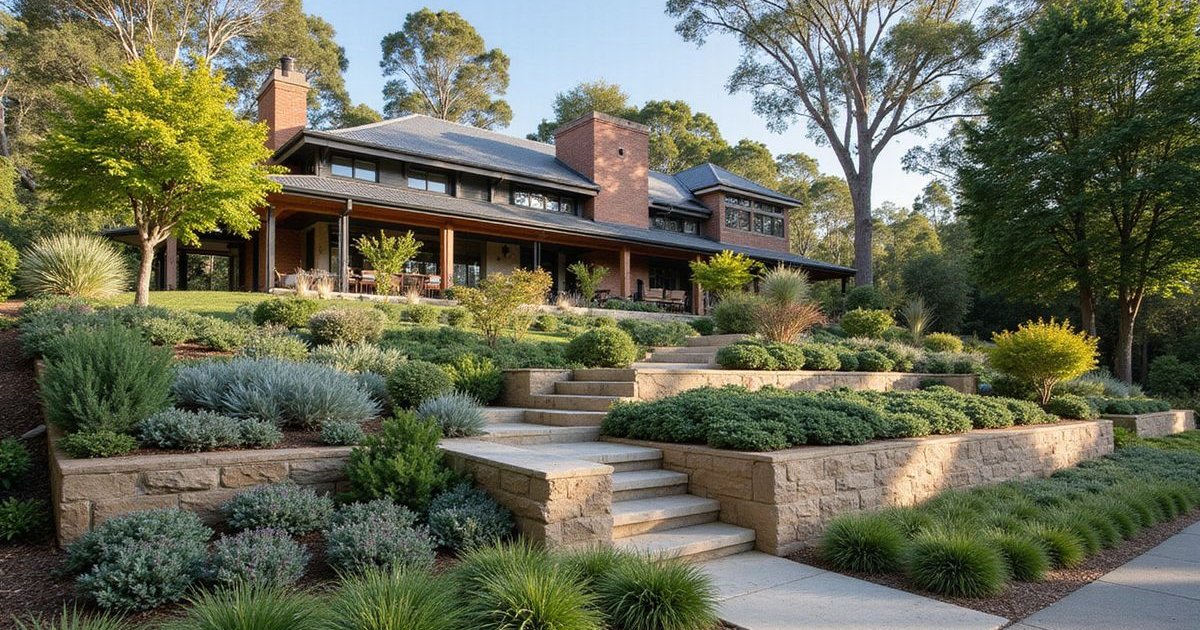
| Natural Stone | Lifetime | Premium aesthetic for visible feature walls in Eltham/Kew. |
| Gabion Cages | 50+ Years | Excellent drainage properties; suits modern or bushland themes. |
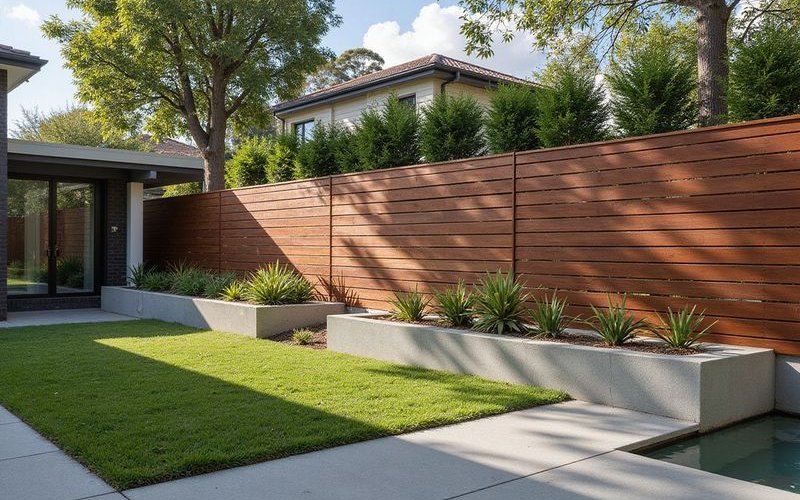
We often recommend mixing materials to balance cost and style. A rendered block wall near the alfresco area pairs well with timber sleeper walls in the lower, less visible sections of the garden.
Terracing
Terracing is effectively the “cut and fill” method of creating usable land.
Why It Works:
- Erosion Control: Breaking a long slope into short steps slows down water velocity.
- Zoning: Each level can serve a different function (e.g., fire pit level, lawn level, veggie patch level).
- Visual Depth: It turns a flat “wall of green” into a layered, interesting view.
Key Design Factors:
- Wall Height: Keeping walls under 1 meter often avoids the need for building permits (check local council rules).
- Connection: How you move between terraces is just as important as the terraces themselves.
- Planting: Terraces create microclimates; upper levels may be drier, while lower levels hold more moisture.
Drainage Systems
Water management is the single most critical factor in steep block landscaping. If the drainage fails, the wall fails.
Essential Components:
- Ag-drains: These 100mm slotted pipes sit behind every retaining wall, wrapped in geofabric to filter out silt.
- Free-Draining Backfill: We use scoria or blue metal gravel behind walls to ensure water drops instantly to the drain.
- Surface Grates: Pits located at low points capture runoff before it creates a bog.
- Legal Discharge Point: All water must be directed to the stormwater system, not your neighbor’s fence.
The “1 in 100 Year” Standard: Recent weather patterns in Melbourne have increased the intensity of storms. Drainage systems must be oversized to handle sudden, high-volume downpours rather than just average rainfall.
Steps and Paths
Movement through the landscape should be intuitive and safe.
Material Options:
- Castlemaine Slate or Bluestone: These local stones offer high slip resistance (R11 rating is ideal).
- Constructed Timber Stairs: Great for floating over tree roots without damaging them.
- Reinforced Concrete: durable and can be formed into curves.
- Exposed Aggregate: Provides excellent grip in wet conditions.
Safety by Design:
- Consistent Risers: Every step height must be identical to prevent tripping hazards.
- Landings: Long flights of stairs require a flat landing every 15-18 steps to allow for rest.
- Lighting: Integrated strip lighting or path lights are mandatory for evening use.
- Handrails: Any drop-off exceeding 1 meter generally requires a balustrade for compliance.
The Design Process for Steep Blocks
Site Assessment
A standard walk-through is not enough for a sloping site.
We conduct a detailed feasibility study that includes:
- Feature Survey: An exact topographic map showing level changes and boundaries.
- Geotechnical Report: Analysis of soil composition to determine footing depths.
- Hydraulic Assessment: Mapping where the water comes from and where it needs to go.
- Vegetation Check: Identifying trees protected by council overlays.
Engineering Requirements
Structural integrity is non-negotiable.
Most steep projects involve:
- Structural Engineers: They calculate the steel reinforcement needed for walls over 1 meter.
- Soil Testing: Determining the reactivity of the clay (Class M, H, or E).
- Drainage Plan: A filed layout often required for building permits.
- Protection Works: Notices served to neighbors if we are digging near the boundary.
Concept Development
This is where engineering meets art.
Successful hillside design requires:
- Balancing Earthworks: We aim to equalize “cut” (soil removed) and “fill” (soil added) to minimize expensive tip fees.
- Gravity Utilization: Using the slope for water features or cascading plants.
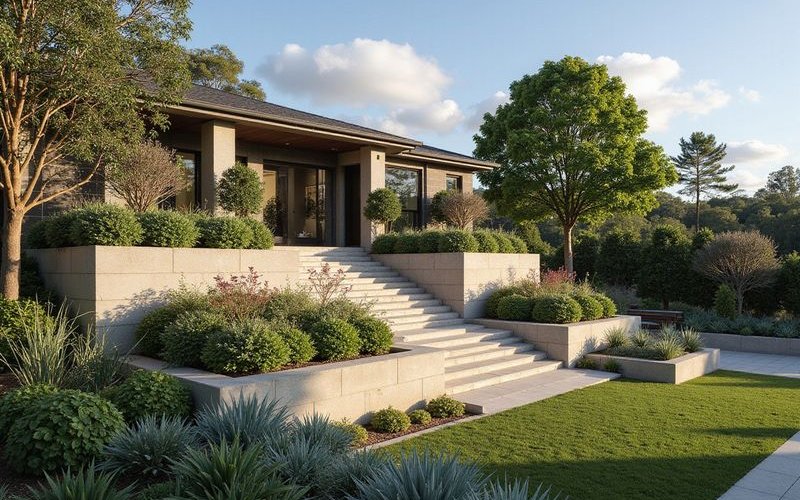
- Sightlines: Positioning seating areas to maximize the views that steep blocks provide.
Real-World Considerations
Budget Realities
Honesty about costs prevents shock later in the project. Steep block landscaping involves logistics that flat sites do not.
Cost Drivers:
- Hand Excavation: If a machine can’t reach it, labor costs increase significantly.
- Materials Handling: Cranes may be needed to lift pallets of stone or sleepers over the house.
- Spoil Removal: Victorian landfill levies make removing soil expensive.
- Engineering Fees: Permits and professional computations add to the preliminaries.
You should budget between $80,000 and $400,000+ for a comprehensive transformation that includes structural walls, drainage, and planting.
Council Requirements
The regulatory environment in Melbourne’s northeast is strict to protect the “Green Wedge” character.
Common Triggers for Permits:
- Earthworks: Moving more than a specific volume of soil.
- Overlays: Vegetation Protection Overlays (VPO) and Significant Landscape Overlays (SLO) are common in Banyule and Nillumbik.
- Tree Protection Zones (TPZ): You cannot dig within a certain radius of significant trees.
- ResCode: Overlooking regulations may apply if a new deck or terrace offers views into a neighbor’s private open space.
We manage these applications as part of the design package, ensuring the project remains compliant.
Construction Challenges
Execution on a slope requires specialized experience.
Logistical Hurdles:
- Staging: There is often no room to stockpile materials, requiring precise “just in time” deliveries.
- Weather Delays: Clay slopes become dangerously slippery slides when wet, halting work for safety.
- Sediment Control: Strict EPA laws require silt fences to prevent runoff entering stormwater drains.
The Transformation
The effort required to tame a steep block is substantial, but the payoff is unmatched.
Dramatic Views Your property becomes a viewing platform. Whether it is city glimpses or tree-top canopies, the elevation provides a vantage point flat blocks cannot replicate.
Natural Integration Gardens feel more immersive when they surround you vertically. We can create “hanging gardens” where trailing plants soften the hardscape.
Privacy Level changes offer the ultimate screening. A sunken fire pit area or an elevated deck creates natural separation from neighbors without needing massive fences.
Visual Interest Shadow and light play differently on a sloped surface. The garden changes character throughout the day as the sun moves across the different levels.
Property Value Usable land is valuable land. Converting a “useless” hill into a functional garden significantly increases the resale appeal of the home.
Our Experience
We are locals, based in Eltham, and we have lived and worked in this terrain since 1981.
Our portfolio spans the entire northeast corridor, including:
- Precision-engineered retaining systems in Doncaster.
- Natural stone terracing for heritage homes in Ivanhoe.
- Bushland regeneration projects in Warrandyte.
- Complex hillside pool coping and surrounds in Kew.
We do not just design for these conditions; we understand the specific soil profiles and microclimates that dictate what will thrive here.
Ready to Transform Your Steep Block?
The terrain might be difficult, but the result is worth the engineering. Contact us to discuss how we can turn that challenging slope into your favorite part of the home.