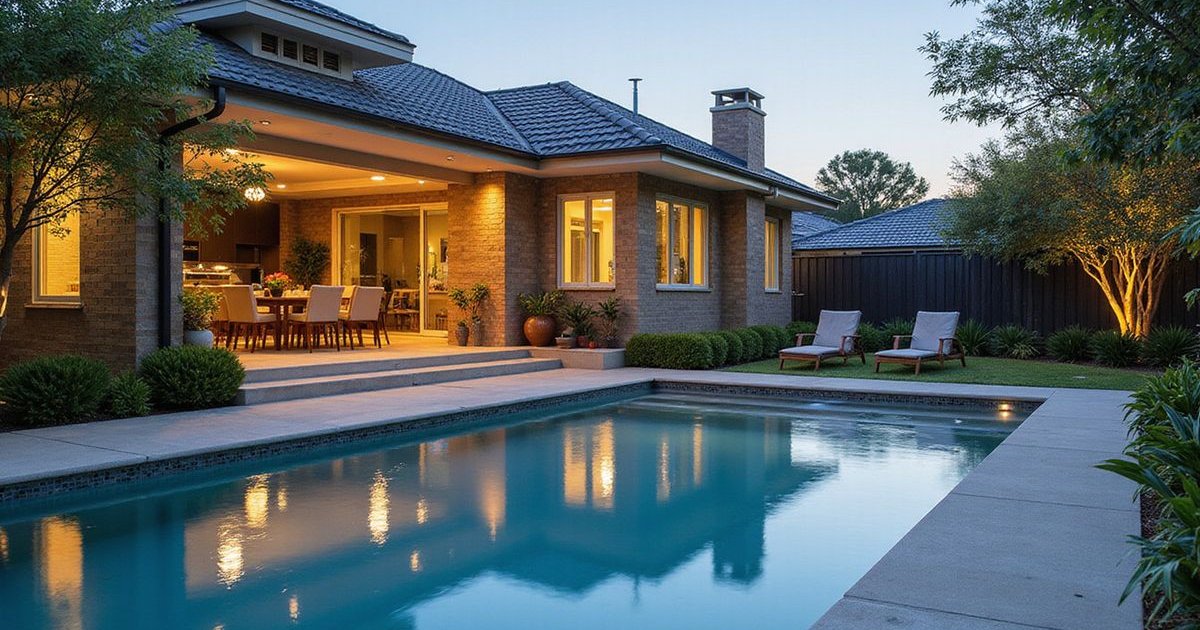
Outdoor Living Spaces: Extending Your Melbourne Home into the Garden
Create seamless indoor-outdoor living with decks, pergolas, and alfresco areas. Design principles for Melbourne's climate and lifestyle.
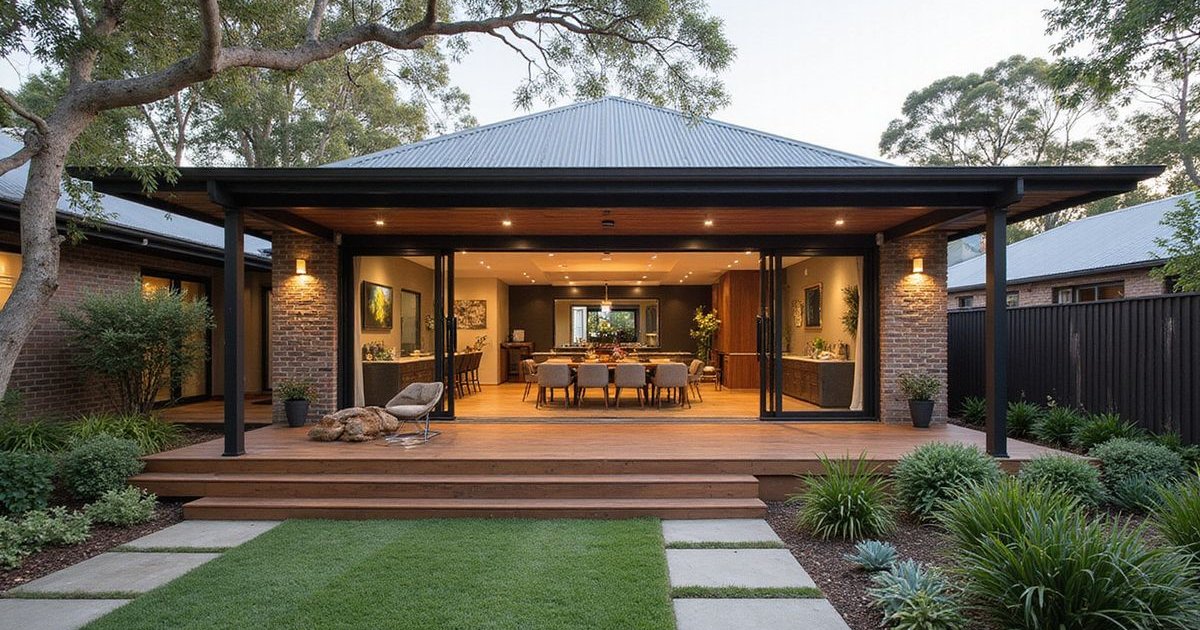
Melbourne’s climate is famous for delivering four seasons in one day.
We have spent over 40 years designing landscapes in Melbourne, and we know that extending your home into the garden requires balancing those shifts between mild autumns and blistering summer afternoons.
Functional outdoor spaces act as a second living room that significantly increases your property’s usable footprint.
Real estate data from 2025 suggests that a well-integrated outdoor living area can increase a Melbourne home’s value by up to 20%.
Our team focuses on creating spaces that remain comfortable regardless of what the weather is doing. Our paving and decking service delivers the quality construction needed to make these spaces a reality.
Here is how to design outdoor living spaces: extending your Melbourne home into the garden with practical solutions that last.
The Indoor-Outdoor Connection
Creating Flow
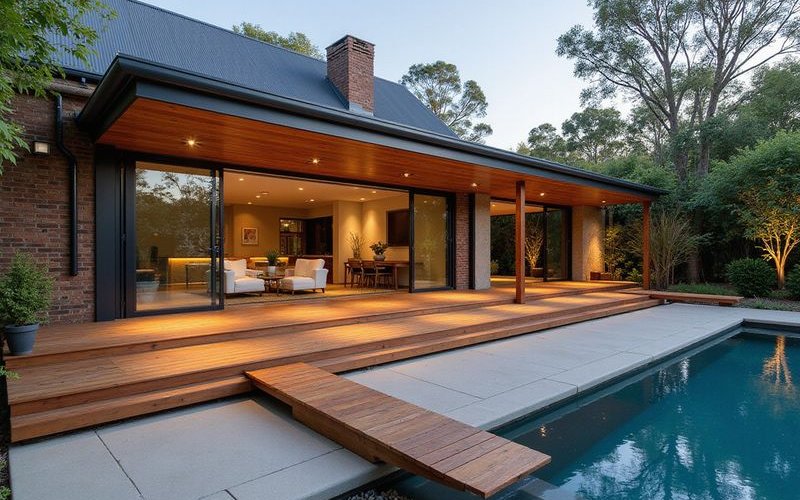
Great outdoor living feels like a natural extension of your home rather than a tacked-on addition.
We prioritize visual and physical continuity to make the transition seamless.
Interior designers often suggest running the same flooring material from inside to out to trick the eye into seeing one large room.
Achieving this effect requires attention to specific details:
- Align door openings: Ensure stacker or bi-fold doors open fully to connect the zones.
- Continuous flooring aesthetics: Use tiles or timber with similar tones (e.g., internal Oak flowing onto external Spotted Gum).
- Sight lines: Position key focal points, like a Japanese Maple or a water feature, so they are visible from the kitchen or lounge.
- Circulation planning: Maintain a minimum 1-meter pathway around furniture groupings for easy movement.
Level Transitions
Managing levels between inside and out is the most critical technical challenge in landscape construction.
We always aim for a flush threshold where the indoor floor meets the outdoor deck or paving at the exact same height.
This “zero-threshold” design eliminates trip hazards and creates a luxury feel.
It does require specific drainage solutions to prevent water ingress during heavy Melbourne downpours.
- Linear drainage: We typically install stainless steel slot drains or “ag drains” between the door track and the outdoor surface.
- Minimal step-downs: If a flush finish isn’t possible due to budget or existing concrete slabs, keep the drop to a maximum of 190mm.
- Ramped access: Grading the land gently can remove the need for steps entirely.
Deck Design
Material Choices
Choosing between natural timber and composite is the most common dilemma for our clients in suburbs like Kew and Ivanhoe.
We break down the comparison based on longevity, maintenance, and fire safety (BAL ratings).
| Feature | Hardwood Timber (Spotted Gum/Ironbark) | High-End Composite (Millboard/Trex) |
|---|---|---|
| Aesthetic | Authentic, warm, varies in grain | Uniform, mimics timber without imperfections |
| Maintenance | High (Oiling every 6-12 months) | Low (Soap and water cleaning only) |
| Heat Retention | Stays cooler in direct sun | Can get very hot (requires lighter colors) |
| Fire Rating | Naturally BAL-29 resistant | Varies (Check specific BAL-rated lines) |
Hardwood Timber
Spotted Gum and Ironbark are our top recommendations for Australian native hardwoods.
These species are naturally dense and resistant to termites.
A well-maintained hardwood deck can last over 25 years.
Composite Decking
Composite materials have improved drastically since the early plastic-looking versions.
We find that premium brands offer fade resistance that natural timber cannot match.
Expect a higher initial investment (often 15-20% more for materials) but significant savings on maintenance products over a decade.
Design Considerations
Planning the layout involves more than just calculating square meters.
We analyze the “aspect” of your yard to determine where the sun hits at 4 PM in January versus 4 PM in July.
- Furniture requirements: Measure your dining table and add 900mm on all sides for chair clearance.
- Garden integration: Use “floating” steps to descend into the lawn rather than closing the deck off with rails, if safety heights permit.
- Zoning: Create distinct areas for cooking, dining, and lounging to avoid clutter.
Shade and Shelter
Pergolas
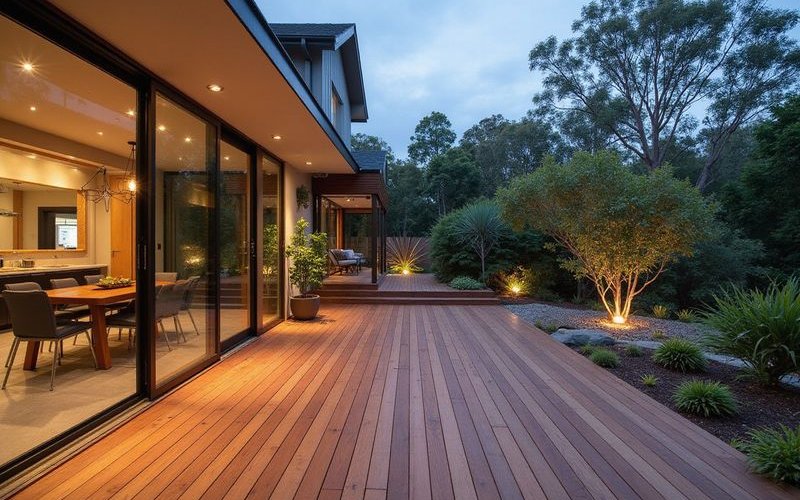
Open structures provide filtered shade and architectural interest without blocking the sky.
We frequently use mixed materials, such as recycled brick piers with steel beams, to match the heritage homes in Melbourne’s northeast.
Fixed battens angled at 45 degrees can block the harsh summer sun while allowing winter light to penetrate.
Alfresco Roofing
Complete weather protection allows you to host Christmas lunch even if it rains.
We recommend insulated roofing panels (like SolarSpan) for these structures.
These panels reduce heat transfer from the sun, keeping the area beneath significantly cooler than a standard colorbond or polycarbonate roof.
Skillion (single slope) designs often work best to tuck under existing house eaves.
Shade Sails
Flexible shade solutions offer a cost-effective alternative to permanent carpentry.
We suggest using high-quality architectural fabrics capable of blocking up to 99% of UV rays.
Proper tensioning requires substantial footings (often 1 meter deep) to withstand Melbourne’s strong northerly winds.
Operable Louvers
Automated opening roof systems are the gold standard for flexibility.
These aluminum louvers rotate 180 degrees at the push of a button.
You can close them completely during a shower or angle them to chase the winter sun.
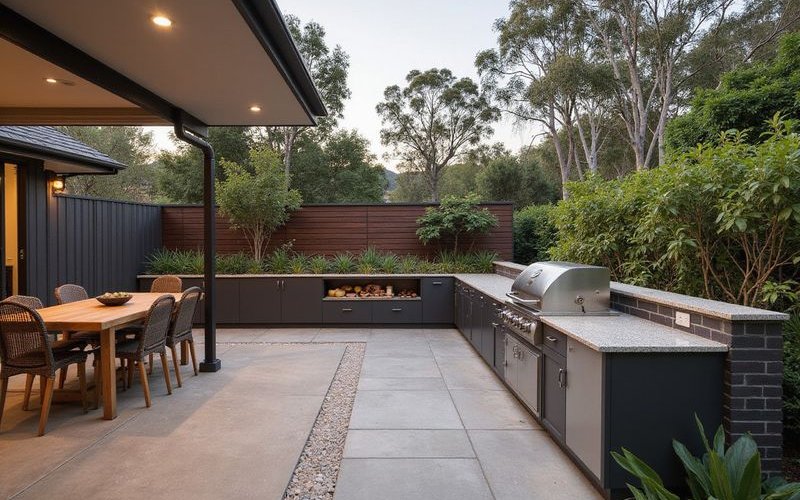
Outdoor Kitchens and BBQ Areas
Basic Setup
A functional BBQ station needs to be durable enough to withstand the elements.
We advise allowing for at least 600mm of bench space on either side of the grill for plates and tongs.
- Built-in BBQ: Choose marine-grade 316 stainless steel to prevent rust.
- Prep bench: Granite or sintered stone (like Dekton) resists stains and scratches better than marble.
- Storage: Ensure cupboard doors have rubber seals to keep spiders and dust out.
Full Outdoor Kitchen
For the serious entertainer, we expand the scope to include wet areas and refrigeration.
Plumbing a sink outdoors requires connection to the sewer system, not just the stormwater drain.
Outdoor fridges must be specifically rated for exterior use to handle ambient temperatures up to 40°C.
- Gas safety: Australian Standard AS 5601 requires specific clearances between the BBQ burner and any combustible material (usually 200mm).
- Rangehoods: If your kitchen is under a roof, a commercial-grade rangehood is mandatory to extract grease and smoke.
Design Tips
Placement is the key to a kitchen that actually gets used.
We try to position the outdoor grill within a short walking distance of the indoor kitchen to make transferring food easy.
Consider the “prevailing wind” direction to ensure smoke blows away from your guests.
Heating and Cooling
Heating Options
Extending the usability of your deck into June and July requires efficient heat sources.
We install electric radiant strip heaters (like Heatstrip) in almost every alfresco project.
Unlike gas patio heaters that heat the air, radiant heaters heat surfaces and skin directly.
Running costs for a 2400W electric heater sit around $0.60 to $0.80 per hour depending on electricity rates.
- Ceiling mounted: keeps floor space clear.
- Fire pits: Check local council regulations in areas like Nillumbik or Banyule regarding smoke and open flames.
Cooling Options
Keeping cool in February is just as important as staying warm in July.
We recommend high-volume, low-speed (HVLS) ceiling fans for covered areas.
The airflow creates a wind-chill effect that can make the ambient temperature feel 4-6 degrees cooler.
- Misting systems: High-pressure mist lines can drop temperatures by 10 degrees but require maintenance to prevent nozzle clogging.
- Passive cooling: Position deciduous trees to the north and west to provide natural summer shade.
Lighting
Good lighting transforms a garden from a black void into a visual feature at night.
We separate lighting plans into three layers: task, ambient, and accent.
All outdoor fixtures must have an Ingress Protection (IP) rating of at least IP65 to withstand dust and water jets.
Task Lighting
This is functional light for safe cooking and movement.
You need bright, focused beams over the BBQ grill and food prep areas.
Step lights recessed into the timber or masonry are essential for safety on any level changes.
Ambient and Feature Lighting
This layer creates the mood.
We prefer warm white globes (2700K to 3000K) rather than cool white, which can look clinical outdoors.
- Spike lights: Uplight feature trees like Silver Birches or Crepe Myrtles to show off their bark texture.
- Strip lighting: Conceal LED strips under bench seats or deck overhangs for a soft glow.
- Festoon lights: String lights add an instant festive atmosphere to open dining zones.
Furniture and Styling
Material Selection
Melbourne’s UV index is extreme, and cheap materials degrade quickly.
We steer clients toward materials that age gracefully or resist the sun entirely.
- Teak: Contains natural oils that repel water; turns a silver-grey if left untreated.
- Powder-coated aluminium: Rust-free and lightweight, making it easy to move.
- Quick-dry foam: Look for “reticulated foam” cushions that allow water to drain through rather than soaking it up like a sponge.
- Performance fabrics: Brands like Sunbrella are the industry standard for fade and mould resistance.
Layout Planning
Treat the furniture layout just as you would an indoor living room.
We create “conversation pits” where sofas face each other rather than lining them up against a wall.
Ensure your dining table size matches your typical guest list, but keep it proportional to the deck size to avoid overcrowding.
Privacy Considerations
Screening Options
Privacy is a premium commodity in inner suburbs.
We use screening to block sightlines from double-story neighbors without making the space feel enclosed.
- Timber slats: Horizontal merbau slats are a classic look that allows airflow.
- Green screens: Fast-growing hedging plants like Syzygium ‘Resilience’ (Lilly Pilly) or Ficus ‘Flash’ are excellent for reaching fence height quickly.
- Laser-cut metal: Decorative screens serve as art pieces while providing cover.
Strategic Design
Good design solves privacy issues through geometry rather than just high walls.
We often use changing levels to sink the seating area slightly, making it harder for neighbors to overlook.
Creating garden “rooms” with layers of planting adds depth and separates the entertainment zone from the functional utility areas.
Melbourne Climate Considerations
Summer
The sun is your main enemy in January and February.
We ensure that west-facing glazing and decks are heavily shaded to prevent the house from baking in the late afternoon.
Cross-ventilation is vital; position openings to catch the southerly cool change that often arrives in the evening.
Winter
Melbourne winters are often gray, so capturing light is essential.
We design structures to admit low-angle northern sun, which naturally warms the home’s interior.
Wind protection from the chilly south-westerlies will make your fire pit area usable even on crisp nights.
Rain
Water management is the unsexy hero of outdoor design.
We calculate roof pitches and box gutter sizes to handle “1-in-100-year” storm events, which are becoming more frequent.
Permeable paving options allow rainwater to soak into the water table rather than overwhelming the stormwater system.
Creating Your Outdoor Room
The best outdoor living spaces feel like rooms without walls—comfortable, functional, and connected to both home and garden.
We believe that with the right planning, your garden becomes the most valuable room in your house.
Consider how you will use the space, what conditions you need to manage, and how it relates to both indoors and the wider landscape.
Ready to create your outdoor living space? Contact us to discuss your project.