Garden Irrigation Systems: A Complete Guide to Automated Watering
Choose and maintain the right irrigation system for your garden. From drip irrigation to smart controllers, ensure your plants receive optimal water efficiently.
In our experience, an efficient irrigation system is the single best insurance policy for your garden. It saves water, reduces maintenance, keeps plants healthy, and gives you peace of mind when you’re away from home.
Founded by John French in 1981, our Melbourne-based firm has spent over four decades designing landscapes in the inner northeast, so we know exactly how the local climate impacts your watering needs. You’ve likely noticed how quickly the clay soils in areas like Eltham or Ivanhoe dry out and crack in summer, only to become waterlogged in winter.
That’s why a “set and forget” approach doesn’t work here. The difference between a thriving garden and a struggling one often comes down to how well your system adapts to these extremes.
This guide covers everything we utilize to keep Melbourne gardens lush, efficient, and compliant with local water rules. Our irrigation and lighting service installs and integrates these systems as part of your landscape project.
Types of Irrigation Systems
Drip Irrigation
How it works: Water is delivered directly to plant roots through pressure-compensating emitters inside the tubing.
Best for:
- Sloped garden beds (common in the northeast suburbs)
- Established shrub areas
- Vegetable gardens
- Dense native plantings
Our Recommendation: We almost exclusively use Netafim Techline AS (Anti-Siphon) for residential projects. The “Anti-Siphon” feature is critical because it prevents dirt from being sucked back into the drippers when the system turns off, which is a common cause of failure in cheaper generic brands.
Advantages:
- 90% water efficiency compared to spraying water through the air.
- Reduced weed growth since you aren’t watering the empty soil between plants.
- Disease prevention by keeping foliage dry (essential for roses and veggies).
- Slope stability as the slow application prevents run-off on steep blocks.
Components:
- Main supply line (poly pipe)
- Distribution tubing (17mm brown tube)
- Air release valves (vital for slopes)
- Filters and pressure reducers
Pop-Up Sprinklers
How it works: Sprinkler heads retract into the ground when off and pop up to spray when activated by water pressure.
Best for:
- Lawns (Buffalo, Couch, Fescue)
- Large open areas
- Sports turf
Types:
- Rotary: These shoot a single stream that rotates.
- Fixed Spray: These spray a constant fan of water (we avoid these in windy areas).
- MP Rotators: High-efficiency multi-stream nozzles.
Our Recommendation: For Melbourne lawns, we prefer Hunter MP Rotators. They deliver water more slowly than standard sprays, which allows our heavy clay soils to absorb the moisture without run-off. They also cut through the wind much better than a fine mist spray.
Advantages:
- Even coverage across irregular shapes.
- Hidden when not in use to protect the aesthetic.
- Covers large areas quickly.
- Easy to clean and adjust.
Micro-Sprays
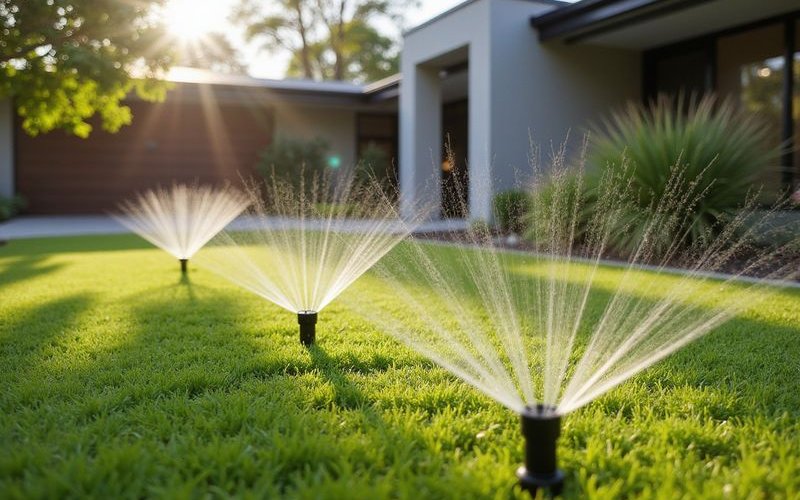
How it works: Small sprayers mounted on stakes that create a fine mist over a small area.
Best for:
- Potted plants (on a separate zone)
- Greenhouses
- Ferneries requiring high humidity
The “Insider” Warning: We generally advise clients to avoid micro-sprays in open garden beds. In a Melbourne summer, the fine mist often evaporates before it hits the soil, and the small nozzles are easily clogged by insects or calcium buildup. Stick to drip irrigation for garden beds whenever possible.
Smart Controllers
Why Go Smart?
Modern smart controllers are not just gadgets; they are money savers. By connecting to local weather stations (like the one at Melbourne Airport or localized suburban stations), they adjust your watering automatically.
Key Benefits:
- Weather-based adjustment: If rain is forecast for Ivanhoe tomorrow, the system cancels tonight’s watering.
- Remote control: You can turn off a stuck valve from your phone while at work.
- Water tracking: Receive alerts if you have a leak (e.g., “High flow detected”).
- Cost Savings: Studies show smart controllers can reduce water usage by up to 50% compared to standard timers.
Smart Controller Comparison
Choosing the right brain for your system is crucial. Here is how the top two contenders stack up for Australian homeowners:
| Feature | Hunter Hydrawise (Pro-HC) | Rain Bird ESP-ME3 + LNK2 WiFi |
|---|---|---|
| Best Use Case | Complex gardens needing precise control | Straightforward “set and forget” setups |
| App Interface | Highly detailed, excellent reporting | Simple, user-friendly |
| Connectivity | Native WiFi built-in | Requires separate LNK2 module |
| Touchscreen | Yes (Full color) | No (Dial and buttons) |
| Est. Price (Au) | ~$400 - $550 | ~$280 - $350 (inc. module) |
Our Pick: We install the Hunter Hydrawise for most clients because its predictive watering is superior for our variable weather.
Basic Controllers
If you don’t have WiFi at the controller location, standard controllers like the Rain Bird ESP-TM2 (non-WiFi version) still provide:
- Timer-based scheduling
- Multiple zones
- Seasonal adjustment (manual % change)
- Rain sensor compatibility
System Design Principles
Zone Creation (Hydrozoning)
One of the biggest mistakes we see in DIY setups is mixing plant types on the same zone. You must group areas by:
- Water requirements: Native grasses drown if watered on the same schedule as a fern garden.
- Sun exposure: A north-facing wall needs 2x the water of a shaded south side.
- Soil type: Clay soils need slower watering than sandy loam.
The “Cycle and Soak” Method
In the northeast suburbs, clay soil has a slow infiltration rate. If you run sprinklers for 20 minutes straight, the last 10 minutes of water often runs off into the gutter.
The Fix: Program your controller to run three cycles of 5 minutes, with a 30-minute break in between. This allows the water to soak in deep, encouraging stronger root growth.
Pressure Management
Proper pressure is the unsung hero of irrigation.
- Too High: Sprinklers mist (fogging), blowing water away.
- Too Low: Heads don’t pop up fully, causing dry spots.
- The Solution: We install Pressure Limiting Valves (PLVs) at the start of the system to ensure a constant 250-300 kPa, protecting your components from bursting.
Installation Considerations
Professional vs DIY
While Bunnings sells all the parts, irrigation is more complex than clicking hoses together.
| Feature | Professional Installation | DIY Project |
|---|---|---|
| Cost (Avg 600m²) | $3,500 - $6,000+ | $1,500 - $2,500 |
| Warranty | Parts & Labour (usually 12-24 mos) | Parts only |
| Compliance | Full plumbing compliance | Risk of non-compliance |
| Best For | Full property, smart systems | Small veggie patches, pots |
The Legal Requirement: Backflow Prevention
This is the most critical safety step that most DIY guides miss. The Law in Victoria: Any irrigation system connected to the mains water supply must have a backflow prevention device installed by a licensed plumber. This prevents contaminated garden water from being sucked back into the drinking water supply.
Your Responsibility: You must have a testable backflow device (like a RPZ valve) if you have chemical injection, or a standard dual-check valve for basic residential systems. Failure to comply can result in fines from Yarra Valley Water or your local retailer.
Maintenance Requirements
Seasonal Checklist
Spring (September - October)
- Turn the main water supply back on.
- Run a “test program” (2 mins per zone) to check for leaks.
- Replace the backup battery in the controller.
- Action: Increase watering to 60-70% capacity as days lengthen.
Summer (December - February)
- Check filters monthly (especially if using greywater).
- Monitor for “dry spots” on the lawn which indicate a blocked head.
- Action: Set controller to 100% capacity. Monitor wind drift.
Autumn (March - May)
- Reduce watering frequency as evaporation slows.
- Clear dead leaves from covering pop-up heads.
- Action: Dial down to 40-50% capacity.
Winter (June - August)
- Turn the system off or to “Rain Off” mode.
- In frost-prone pockets like the Yarra Valley, drain the mainline to prevent pipe bursts (though rare in metro Melbourne).
Water Efficiency Tips
Follow the Rules
Melbourne has Permanent Water Saving Rules in place regardless of dam levels.
- The Rule: You can only use a watering system between 6pm and 10am.
- The Exception: You can use a hand-held hose fitted with a trigger nozzle at any time.
Smart Planting
Use indigenous plants from the local area (like Correas or Lomandras). Once established, they often survive on rainfall alone, allowing you to cap off those irrigation zones completely.
Common Problems and Solutions
Problem: High water bills despite smart controller. Solution: You likely have a weeping valve. Check if heads are damp when the system is off. Replace the diaphragm inside the solenoid valve.
Problem: Foxes or rodents chewing drip lines. Solution: This is common in leafy suburbs. Bury the drip line at least 50-70mm under mulch. If damage persists, switch to subsurface drip (buried under soil) which uses copper-shielded emitters to repel roots and rodents.
Problem: Uneven coverage (Green circles on lawn). Solution: Your pressure is too low or heads are spaced too far apart. Install a new nozzle with a further throw or add an additional head to ensure “head-to-head” coverage.
Getting Started
An efficient irrigation system requires proper design, quality components, and strict adherence to Victorian plumbing codes. While simple drip lines for pots can be a weekend project, a fully integrated system for a large property benefits from professional planning.
Ready to secure your garden’s future? Contact us to discuss a system design that fits your landscape.