Best Plants Around Pools: Low-Maintenance Poolside Planting for Melbourne
Choose the right plants for your pool surrounds. Low-debris, salt-tolerant, and root-safe species that thrive in Melbourne's climate without causing pool problems.
Cleaning the pool filter is nobody’s idea of a relaxing weekend.
We know that choosing the right plants for your pool area is about more than just aesthetics.
The wrong selection quickly turns a backyard oasis into a maintenance nightmare of clogged skimmer boxes and cracked pavers.
Our team at John French Landscape Design has spent over four decades creating gardens in Melbourne’s inner northeast.
We have seen firsthand how the local climate and heavy clay soils in suburbs like Eltham and Ivanhoe dictate what truly survives poolside.
This guide will help you select species that look stunning, handle the harsh reflected heat of Australian summers, and keep your pool water pristine. Our pool landscaping expertise ensures your planting choices complement both aesthetics and functionality.
What to Avoid Near Pools
You might love the look of a specific tree, but it could be a disaster waiting to happen near water.
We advise clients to steer clear of plants that drop excessive organic matter or have aggressive root systems.
These species increase your cleaning workload and can actively damage your expensive pool shell and plumbing.
The “Do Not Plant” List
| Plant Category | Specific Examples | The Problem |
|---|---|---|
| Messy Deciduous Trees | Liquidambar, Plane Trees | Constant leaf drop clogs filters and alters water pH. |
| Invasive Root Systems | Rubber Plants (Ficus), Willows | Roots seek water aggressively, often cracking pipes and lifting coping. |
| Flowering Mess-Makers | Jacaranda, Bougainvillea | Petals and bracts are nearly impossible to skim out of the water completely. |
| Running Bamboo | Phyllostachys species | Highly invasive runners can penetrate pool liners and paving. |
The Safety Zone: Climbing Hazards
There is a critical safety regulation often overlooked by DIY landscapers.
We always check the Victorian Building Authority (VBA) regulations regarding the Non-Climbable Zone (NCZ).
Current standards (AS 1926.1) generally require a 900mm arc from the top of the pool fence where no climbable objects can exist.
Sturdy branches or rigid shrubs in this zone effectively turn your safety fence into a ladder for young children.
Other Issues
- Allergens: Avoid high-pollen producers like certain Wattles near lounging areas.
- Bee Magnets: Lavender and rosemary attract bees, which increases the risk of stings for wet swimmers.
- Spikes: Cacti or thorny roses are dangerous near barefoot traffic zones.
Top Poolside Plants
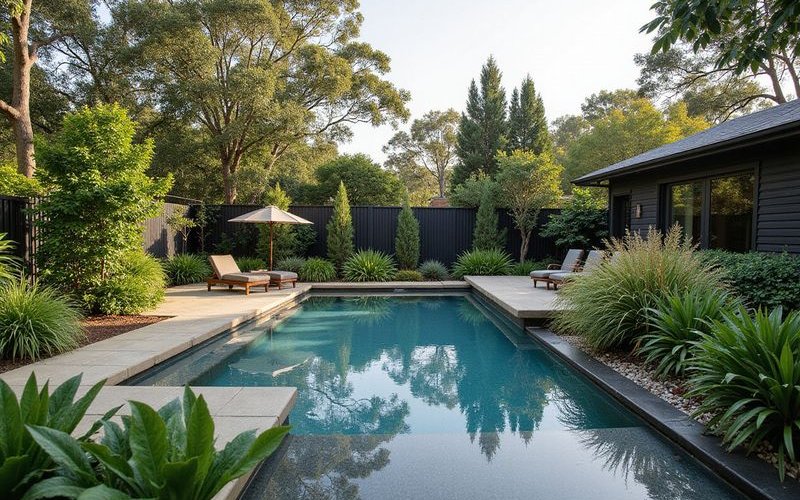
The ideal poolside plant is hardy, evergreen, and “clean.”
We prioritize plants that hold their leaves and can tolerate the chemical splash from chlorine or salt water.
Ornamental Grasses
Grasses add movement and texture without the mess of dropping branches.
They soften the hard edges of paving and coping.
Lomandra ‘Tanika’ (Lomandra longifolia)
- Why it works: This improved cultivar is virtually unkillable in Melbourne conditions.
- The benefit: It stays green year-round and does not flop over pathways like older varieties.
- Maintenance: Requires a simple “haircut” once every 2-3 years to remove thatch.
Dianella ‘Little Rev’ or ‘Cassa Blue’ (Flax Lily)
- Why it works: These varieties offer striking blue-green contrast against blue pool water.
- The benefit: Their compact root systems are safe near plumbing lines.
- Hardiness: Highly drought-tolerant once established.
Miscanthus (Maiden Grass)
- Why it works: Offers a taller, screening effect that dances in the breeze.
- The benefit: Provides privacy without creating a solid, imposing wall.
- Note: While beautiful, some varieties are deciduous, so we recommend planting them slightly further back from the water’s edge.
Succulents and Agaves
These architectural plants are perfect for modern, low-maintenance gardens.
We often use them to create focal points in narrow garden beds.
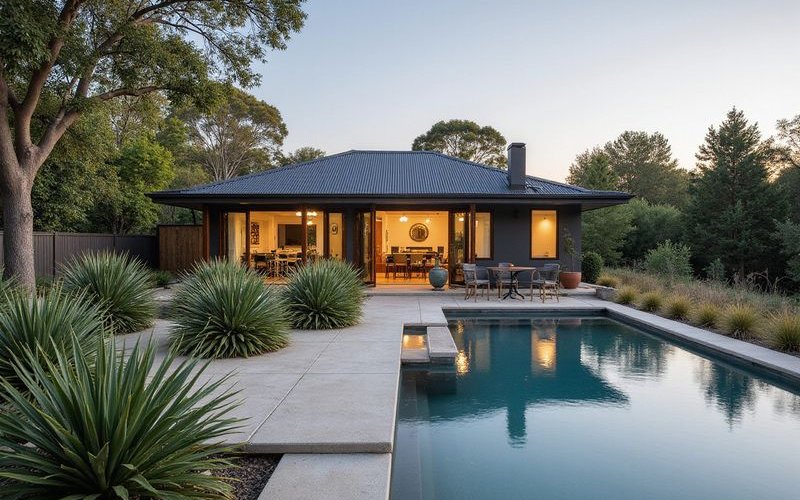
Agave attenuata (Foxtail Agave)
- Why it works: This is the soft-leaved agave, meaning it has no dangerous spikes.
- The benefit: It forms a bold, sculptural rosette that looks incredible when up-lit at night.
- Warning: It is sensitive to heavy frost, so it needs protection in exposed areas of the outer suburbs.
Aloe ‘Bumblebee’ or ‘Gemini’
- Why it works: These hybrid aloes stay compact and flower prolifically.
- The benefit: They provide winter colour when the rest of the garden is dormant.
- Durability: Exceptionally heat tolerant, thriving in the reflected sun off pool paving.
Palms
Palms instantly evoke a resort atmosphere.
We recommend specific species that handle Melbourne’s cooler winters better than their tropical cousins.
Rhapis excelsa (Lady Palm)
- Why it works: A clustering palm that is excellent for shaded corners or pots.
- The benefit: It creates a dense screen from the ground up, hiding fence lines effectively.
- Growth: Slow-growing and easy to contain.
Cycas revoluta (Sago Palm)
- Why it works: Technically a cycad, it offers a prehistoric, rugged aesthetic.
- The benefit: extremely slow growing and produces almost zero leaf litter.
- Caution: All parts of this plant are toxic to dogs, so we avoid it in households with inquisitive pets.
Tropical Style Alternatives
You can achieve a lush, Balinese look without using delicate tropical plants that fail in Victoria.
We select hardy lookalikes that survive the 5°C winter mornings.
Strelitzia reginae (Bird of Paradise)
- Why it works: The orange flowers are iconic and the foliage is leathery and tough.
- The benefit: Unlike the Giant Bird of Paradise (Strelitzia nicolai), this variety stays under 2 metres and is far less likely to damage pipes.
- Resilience: Handles wind and salt spray exceptionally well.
Cordyline ‘Red Star’ or ‘Electric Pink’
- Why it works: Adds a vertical punch of burgundy or pink to a mostly green landscape.
- The benefit: Their upright growth habit takes up very little ground space.
- Tip: Remove old bottom leaves manually to keep the trunk looking tidy.
Groundcovers
Covering the soil keeps roots cool and suppresses weeds.
We use groundcovers to spill over retaining walls or fill gaps between pavers.
Myoporum parvifolium (Creeping Boobialla)
- Why it works: A native powerhouse that forms a dense, weed-suppressing mat.
- The benefit: White flowers in summer look like snow and attract beneficial insects.
- Feature: Highly resistant to salt splash.
Carpobrotus rossii (Native Pigface)
- Why it works: This succulent groundcover locks moisture into the soil.
- The benefit: The vibrant pink flowers are a classic Australian coastal look.
- Durability: It creates a fire-retardant mat and requires almost no supplemental water once established.
Planting Design Tips
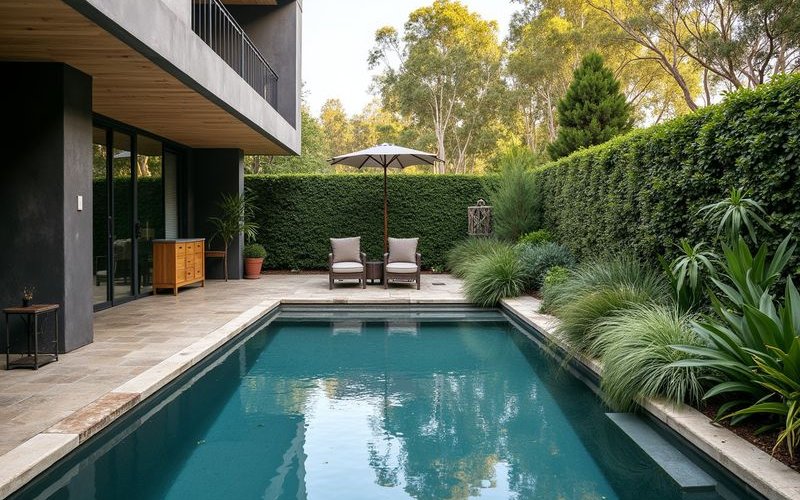
Create Layers
A flat garden lacks visual interest.
We design with three distinct tiers to create depth and privacy.
- Rear Layer: Screening plants (like Syzygium ‘Backyard Bliss’) to hide fences.
- Middle Layer: Textural plants (like Agaves or Philodendrons) for body.
- Front Layer: Groundcovers to soften the hard edges of the pool coping.
Consider Reflected Heat
Paving and water reflect intense UV radiation.
We measure surface temperatures near pools that often exceed 50°C in summer.
Delicate ferns or maples will scorch in these positions.
Always choose plants labeled as “heat tolerant” or “coastal” for the immediate pool perimeter.
Salt and Chemical Tolerance
Modern pools use different sanitation systems that impact plant health.
Saltwater Pools: Splash out creates saline soil conditions. Coastal species like Westringia and Pigface are essential here.
Magnesium/Mineral Pools: These are generally gentler on flora. However, you should still rinse foliage with fresh water if heavy splashing occurs.
Root Protection
The biggest hidden cost in pool landscaping is subterranean damage.
We recommend installing a root barrier (a heavy-duty plastic membrane) for any tree planted within 2 metres of the pool shell.
This simple measure directs roots downward rather than sideways toward the water source.
Planting Zones
Immediate Pool Edge (0-1m)
This is the “Splash Zone.”
- Best choice: Low succulents or tough groundcovers.
- Avoid: Anything with thorns or bees.
- Goal: Keep pathways clear and visibility high.
Adjacent Areas (1-3m)
This is the “Frame.”
- Best choice: Medium shrubs (1-2m high) and clumping grasses.
- Goal: Provide wind protection and visual softening.
- Tip: Ensure these plants do not cast shade on the pool during peak swimming hours (11 am - 3 pm).
Outer Zone (3m+)
This is the “Backdrop.”
- Best choice: Larger screening trees or canopy providers.
- Goal: Privacy from neighbours and shade for lounging areas.
- Selection: Citrus trees can work well here if positioned away from the prevailing wind to minimize leaf drop into the water.
Melbourne Climate Considerations
Summer Heat
Melbourne summers are dry and scorching. Irrigation is non-negotiable for pool gardens. We install subsurface drip irrigation to deliver water directly to the roots, minimizing evaporation.
Winter Chill
Winter brings frosts, especially in the Yarra Valley and leafy northeast. Tropical plants like Frangipanis will rot if left exposed. Stick to temperate alternatives or plant tropicals in pots that can be moved.
Soil Conditions
Many pool excavations in Melbourne hit heavy clay or bedrock. We almost always amend the soil with gypsum and organic compost before planting. Raised garden beds are an excellent solution to provide the drainage that Mediterranean plants like Rosemary and Olives require.
Creating Your Poolside Paradise
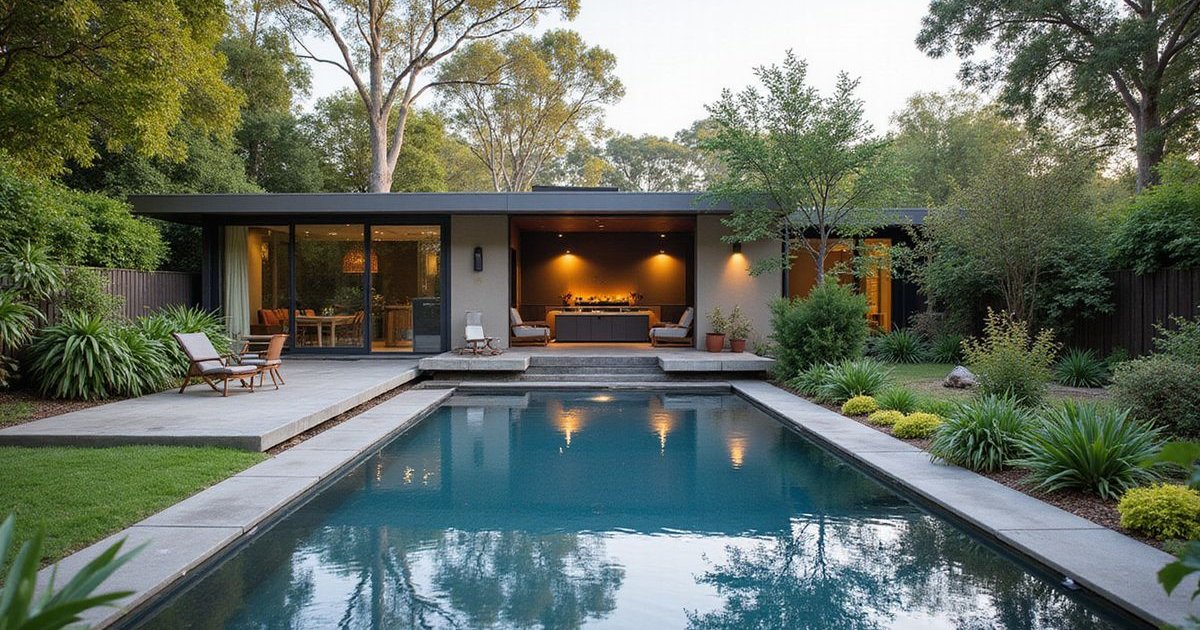
The best poolside planting creates a resort-like atmosphere while keeping your maintenance schedule empty.
We believe your garden should enhance your lifestyle, not add to your chore list.
By choosing the right plant for the right zone, you protect your investment and ensure crystal clear water all summer long.
Need help selecting plants for your pool area? Contact us to discuss your poolside planting design.